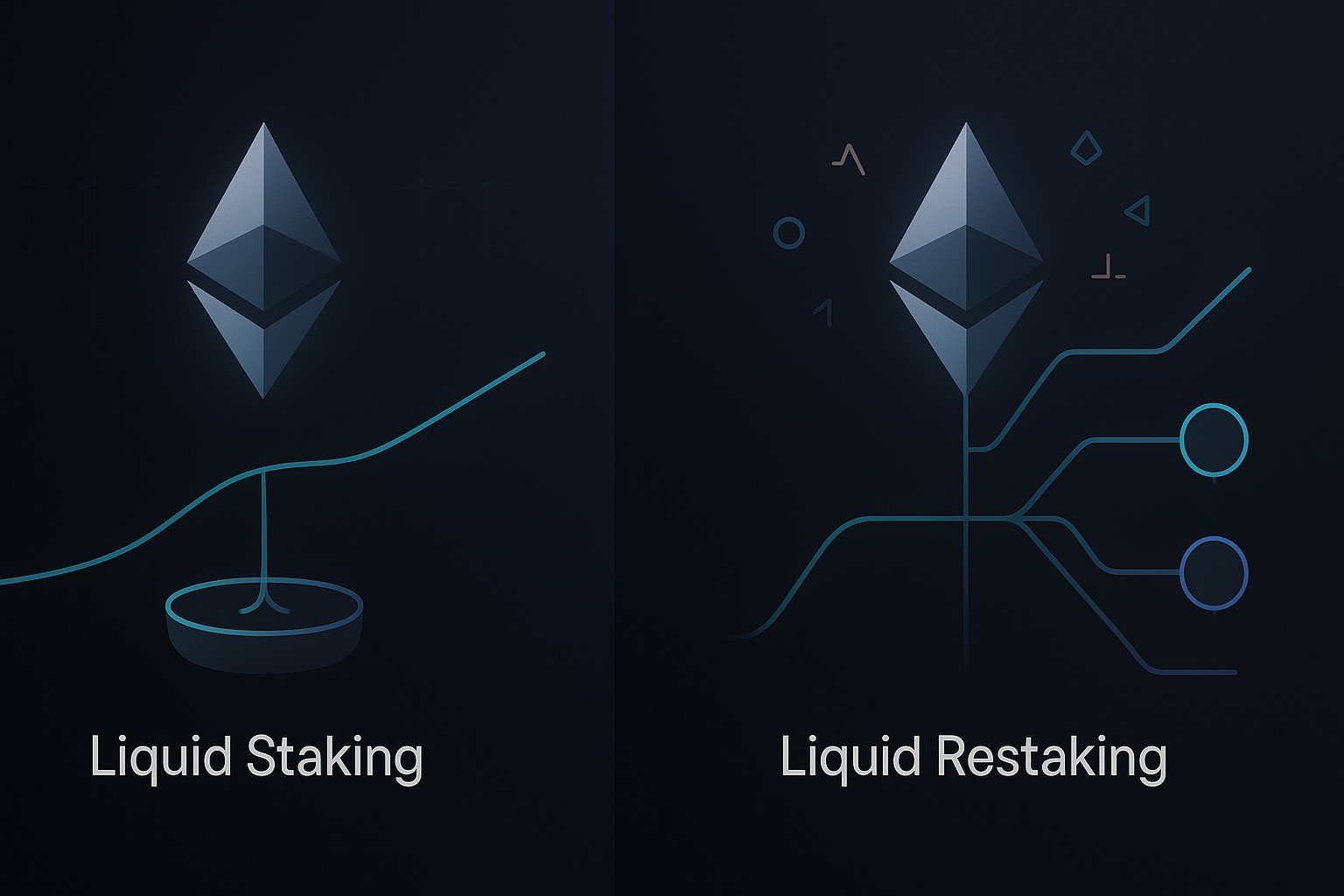
Liquid Restaking vs Liquid Staking
Both concepts let holders keep their assets active, but the mechanics and incentives differ in subtle ways that can influence a trader’s or DeFi user’s strategy.
What liquid restaking vs liquid staking Means in 2026
By 2026, the liquid staking model has matured into a staple for yield farming, offering tokenized representations—LSTs—that grant liquidity without forfeiting staking rewards. Liquid restaking builds on that foundation. It re‑allocates existing validator stakes through a secondary layer, producing LRTs that can earn additional income streams.
The distinction lies in the source of the yield: LSTs rely on the base network’s staking protocol, while LRTs tap into auxiliary services, such as cross‑chain bridging or protocol incentives.
How liquid restaking vs liquid staking Actually Works
With liquid staking, you deposit your native token into a custodian. The platform locks it in the validator set and issues an equivalent amount of a liquid token—an LST. You can then lend, trade, or stake that LST elsewhere.
Liquid restaking takes a step further. The LST is delegated to a restaking protocol—often a smart contract that aggregates validator power across multiple chains or layers. The restaking contract redelegates that stake to additional opportunities, generating extra yield while still keeping the original staking reward intact.
Key Contract Flow
Deposit → Validator lock → LST issuance → Restaking contract → Dual reward streams.
How Traders / Investors / Users Apply liquid restaking vs liquid staking
Stakers with a high risk appetite might prefer liquid restaking because the restaking contract can access incentives from several protocols, like EigenLayer or Layer‑2 rollups.
Conversely, users seeking lower exposure to smart‑contract risk often stay with pure liquid staking, using LSTs as collateral or liquidity provider tokens.
Typical Use Cases
- Yield optimization farms that accept LRTs as input.
- DeFi protocols that peg liquidity to the value of both LST and LRT.
- Insurance vaults that lock LRTs for higher capital efficiency.
Benefits and Trade Offs
LSTs offer predictable rewards and a single layer of risk—just the custody contract. Their price volatility is tied directly to the base token’s staking rate.
LRTs can boost annual returns by leveraging additional incentives, but they introduce a second layer of smart‑contract exposure. If the restaking contract misbehaves, both the original stake and the new yield can be jeopardized.
Higher yield equals higher risk. Evaluate the restaking protocol’s audit status before locking funds.
Key Risks and How to Handle Them
Smart‑contract bugs in the restaking layer can result in slashing or loss of the underlying stake. Regulatory uncertainty also looms, especially when restaking spans jurisdictions.
Liquidity risk emerges when an LRT’s price drops due to a shift in restaking incentives. Users should diversify between LSTs and LRTs and monitor on‑chain metrics like uptime and validator health.
Never lock more than 30% of your portfolio in a single restaking contract.
How to Research or Evaluate liquid restaking vs liquid staking
Start with the protocol’s audit history. A multi‑audit track record, especially from firms familiar with stake‑delegation contracts, is a good sign.
Check the restaking yield curves: EigenLayer yield data and LRT tokenomics should be transparent. Compare the APYs of the base LST versus the LRT, and factor in slashing penalties.
On‑Chain Data Checks
Monitor validator set distribution, commission rates, and the restaking contract’s on‑chain governance decisions.
Where This Could Go in the Future
As Layer‑2 scalability matures, restaking could become a bridge between on‑chain staking and cross‑chain DeFi. Projects like EigenLayer aim to let users “re‑stake” the same stake across multiple protocols, potentially yielding a 20%–30% boost in annualized returns.
Regulatory frameworks may also standardize restaking contracts, providing clearer risk disclosures and compliance pathways for institutional players.
Conclusion
The choice between liquid restaking vs liquid staking ultimately hinges on your appetite for smart‑contract risk versus reward potential. Both models offer liquidity, but the second layer of restaking can amplify returns at the cost of extra exposure.
FAQ
What is the main difference between an LST and an LRT?
An LST is a token that represents staked native coins, while an LRT token is issued after that stake has been restaked to generate additional incentives.
Can I earn from both LST and LRT at the same time?
Yes. Many protocols allow you to deposit LSTs into a restaking contract, earning the base staking reward plus extra yield from the restaking layer.
Is liquid restaking safe for long‑term holders?
It can be, but long‑term holders should assess the restaking contract’s audit record, slashing risk, and the overall governance structure before committing.